
What is Scheurmann's Disease?
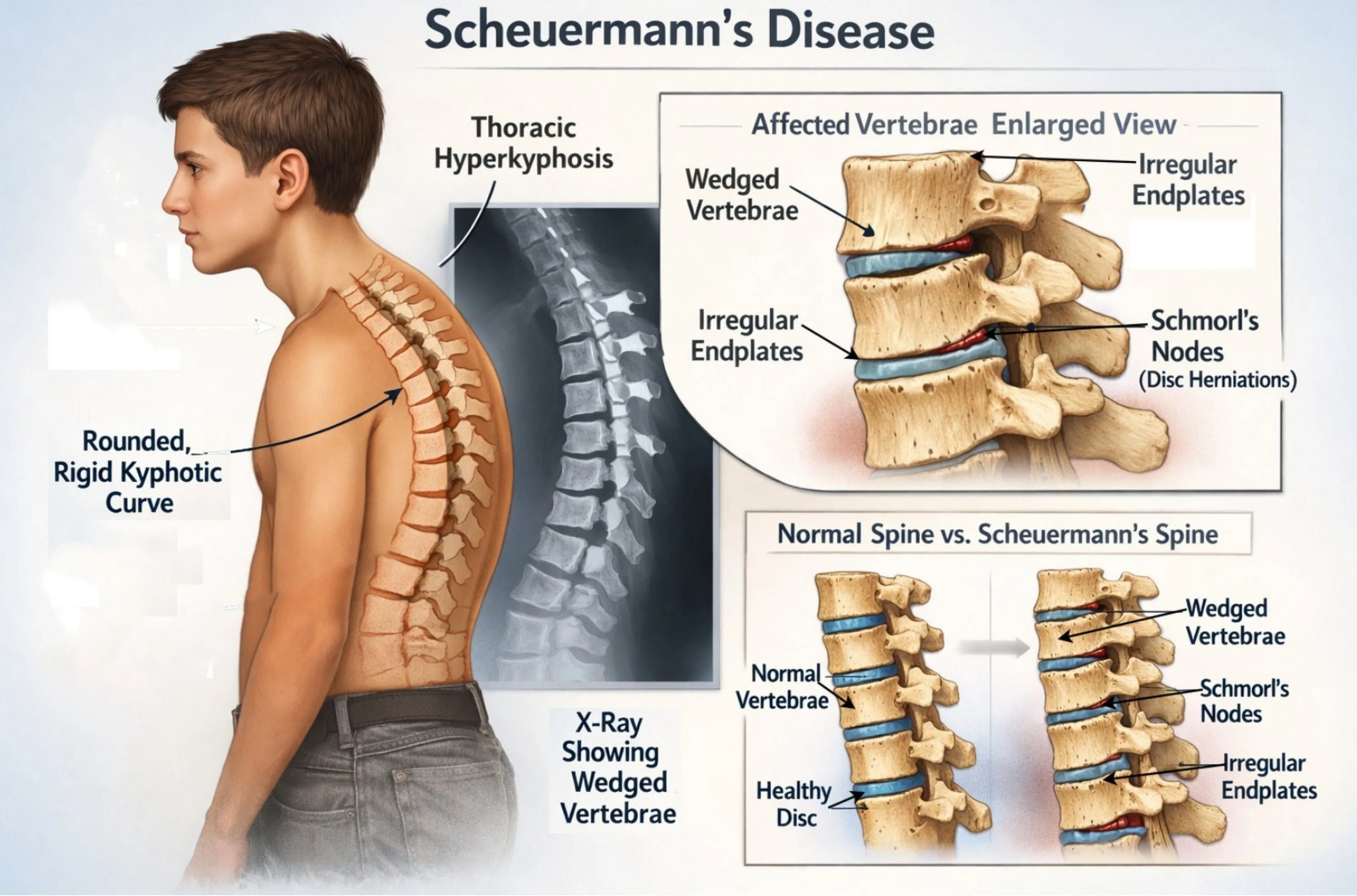
Scheuermann's disease is a structural spinal disorder causing rigid kyphosis due to wedge-shaped vertebrae, typically developing during adolescence.
Posted
Scheuermann's disease is a structural spinal disorder causing rigid kyphosis due to wedge-shaped vertebrae, typically developing during adolescence.
Causes and Risk Factors
The exact cause is unknown, but Scheuermann's disease is thought to be multifactorial. Genetic factors play a role, as familial cases have been reported, and twin studies suggest a significant hereditary component. Mechanical stress, trauma, and abnormal collagen formation in vertebral endplates may contribute. Some patients may also have concurrent juvenile osteoporosis or disproportionate trunk and limb lengths
Symptoms
- Postural changes: Rounded shoulders, hunchback appearance, or slouched posture.
- Pain: Persistent low-grade backache, often aggravated by physical activity, prolonged standing, or sitting.
- Spinal rigidity: The apex of the kyphotic curve is stiff and cannot be consciously corrected.
- Visual deformity: More pronounced in upper thoracic curves, while lower thoracic curves may cause more pain

Diagnosis
Diagnosis is primarily radiographic. Lateral spinal X-rays reveal:
- Anterior wedging of ≥5° in three or more consecutive vertebrae.
- Endplate irregularities and Schmorl’s nodes.
- Thoracic kyphosis with a Cobb angle typically ≥40–45°.
CT or MRI may be used in atypical cases or to rule out other conditions like spinal tuberculosis or generalized skeletal dysplasia
Types
- Type I: Thoracic spine only.
- Type II: Thoracic and lumbar spine involvement
Treatment
Management depends on severity and symptoms:
- Conservative: Reduction of strenuous activity, physical therapy, postural exercises, and bracing for larger curves.
- Surgical: Considered for severe deformities or progressive curves causing pain or functional impairment. Surgery aims to correct spinal alignment and prevent further progression
Prognosis
Most patients have a good long-term outcome with conservative management, though some may experience chronic back pain or cosmetic concerns. Early detection and appropriate intervention can improve posture, reduce pain, and prevent progression